
10 Audition Tips for Future Trombone Applicants
Most applicants have now auditioned, either in person or by recording, though a few are still scheduled in the coming weeks. After listening to many auditions this year and over the past several years, I wanted to share a few observations that may help students preparing for future auditions.
If you ever have questions about the process, feel free to email me. I am always happy to help.
Quick Advice (TL;DR)
Communicate through email professionally.
Read the audition information on the website.
Take a lesson before your audition if possible.
Start the audition with your strongest piece.
Understand the musical context of what you are playing.
Choose repertoire that shows your strengths.
Be ready to explain why you want to study music.
Ask about alternate audition dates if needed.
Learn how to pronounce your teacher’s name.
If offered a lesson after the audition, take it.
If you want more detail, here is the longer explanation behind each one.
1. Communicate.
Email is best, especially since many of you are under 18 and I prefer not to connect through DMs with minors. It is simply a more professional way to communicate, and your parents or guardians will likely appreciate it as well. If you are nervous about reaching out, your band director can always contact me on your behalf. Ideally you learn to do this yourself, but any step forward is a good one. When you write, keep it simple and professional. Say hello, ask your question, and close with something like “sincerely” or “best wishes” followed by your name.
2. Explore the website.
I have spent a lot of time building resources about applying to the University of Alabama and the School of Music, along with links to important steps in the process. Many questions are already answered there. If something still does not make sense, or your situation is unique, I am always happy to help via email.
3. Take a lesson before your audition.
This helps in several ways. You will see Room 108, where auditions take place, and you will get a feel for my teaching style. I often incorporate quick teaching moments into auditions. For example, I might say, “On the third line of the Bordogni, let’s work on this passage.” That kind of interaction is much less intimidating if you have experienced it before. If visiting in person is not possible, a Zoom lesson or video feedback works well too. Personally, I would want to know how a prospective teacher works.
4. Lead with your best piece.
I let applicants start with whichever piece shows them at their best. Some students seem surprised by that freedom. Maybe it is unusual not to dictate the order, but this is how I prefer to run auditions and it is unlikely to change.
5. Know the context of what you are playing.
You do not need to know the entire Latin text of the Requiem Mass, but you should know what “Tuba Mirum Spargens Sonum” means in the Mozart Requiem. Those words explain why you are playing the excerpt. If you bring a Mahler excerpt, I will probably ask about the German context as well. Do a little translating ahead of time.
6. Choose repertoire that represents you well.
Years ago, a student performed bass trombone repertoire on tenor because they had been told their low register was weak and needed work. Unfortunately, the audition ended up highlighting the weakest part of their playing. They were a strong musician who improved greatly over the next four years, but that audition created an unnecessary obstacle.
7. Know why you want this major.
If I ask something like, “Why music education?” it is fair to expect a thoughtful answer. It does not need to sound like a campaign speech, but a little reflection goes a long way. You probably already know your reasons, but you may not have had to articulate them before.
8. If audition dates do not work, tell me.
Some of the best auditions happen outside official audition days. When we are not moving quickly through several auditions in a row, we have more time to talk. I enjoy those conversations, especially when they involve your future. If we can find another day on the calendar, it can be a great experience.
9. Know how to pronounce the professor’s name.
My last name can be confusing. Telemarketers have pronounced “Faske” in every possible way, so I rarely notice anymore. The correct pronunciation is FAH-skee. Learn how to pronounce and spell the names of the professors on your audition list. Many teachers appear on podcasts or livestreams, so it is usually easy to hear how we say our own names.
10. If a teacher offers you a lesson after the audition, take it.
It does not cost you anything beyond what you already invested in making the audition happen, and it can feel dismissive if you decline. More importantly, why would you not want to experience a lesson with the teacher at the school where you are auditioning? Always take advantage of those opportunities.
Auditions are not just about proving what you can already do. They are also about showing your potential and giving both the student and the teacher a chance to see if the fit is right. My goal during auditions is not simply to judge a performance, but to learn how you think, how you respond to feedback, and how we might work together over the next several years.
If you are considering applying to the University of Alabama and would like to schedule a lesson, ask a question, or simply introduce yourself, feel free to reach out by email. I look forward to hearing from you.
A New Feature at rollslide.com!
UA Trombone Studio Blog!
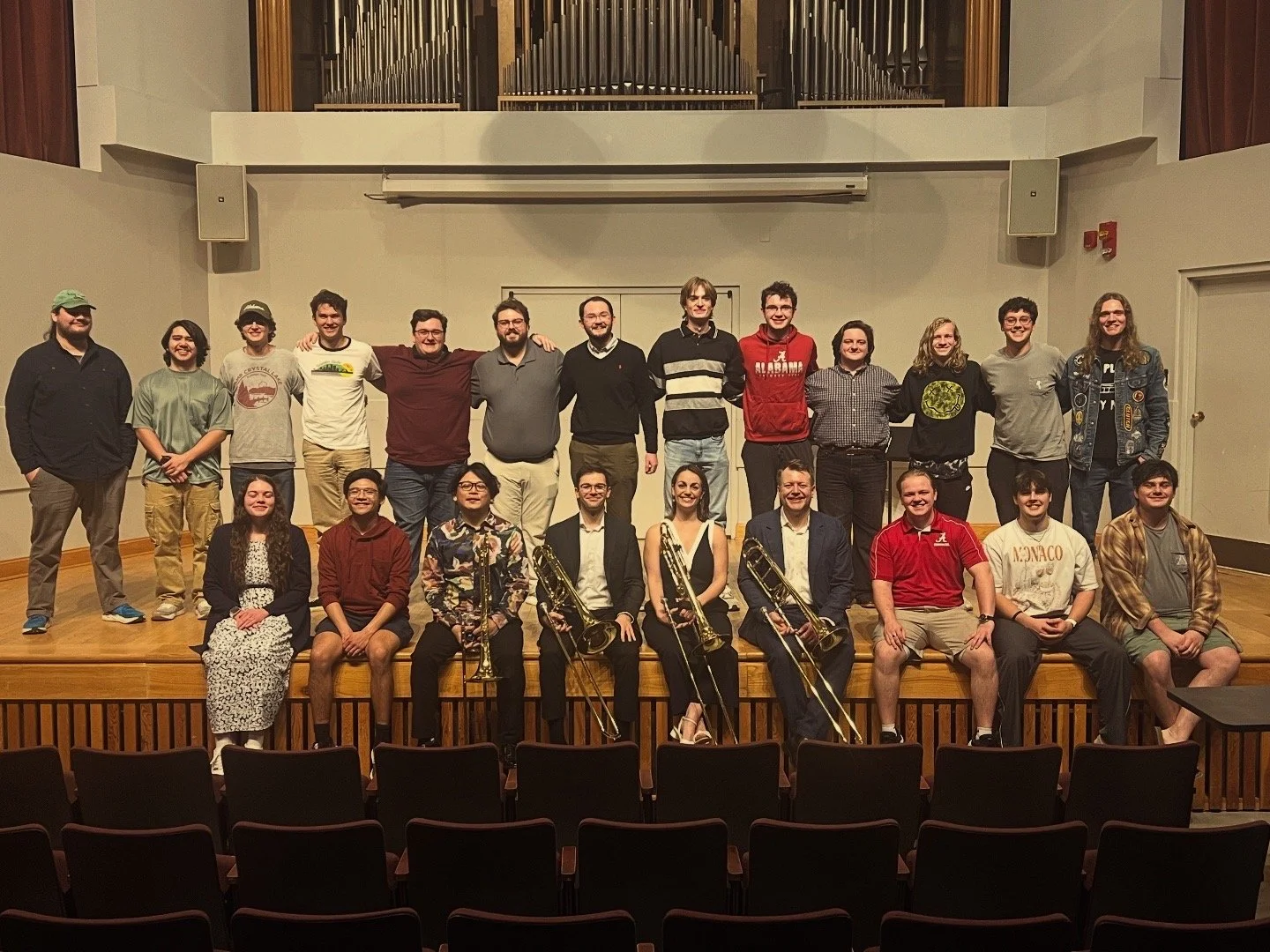
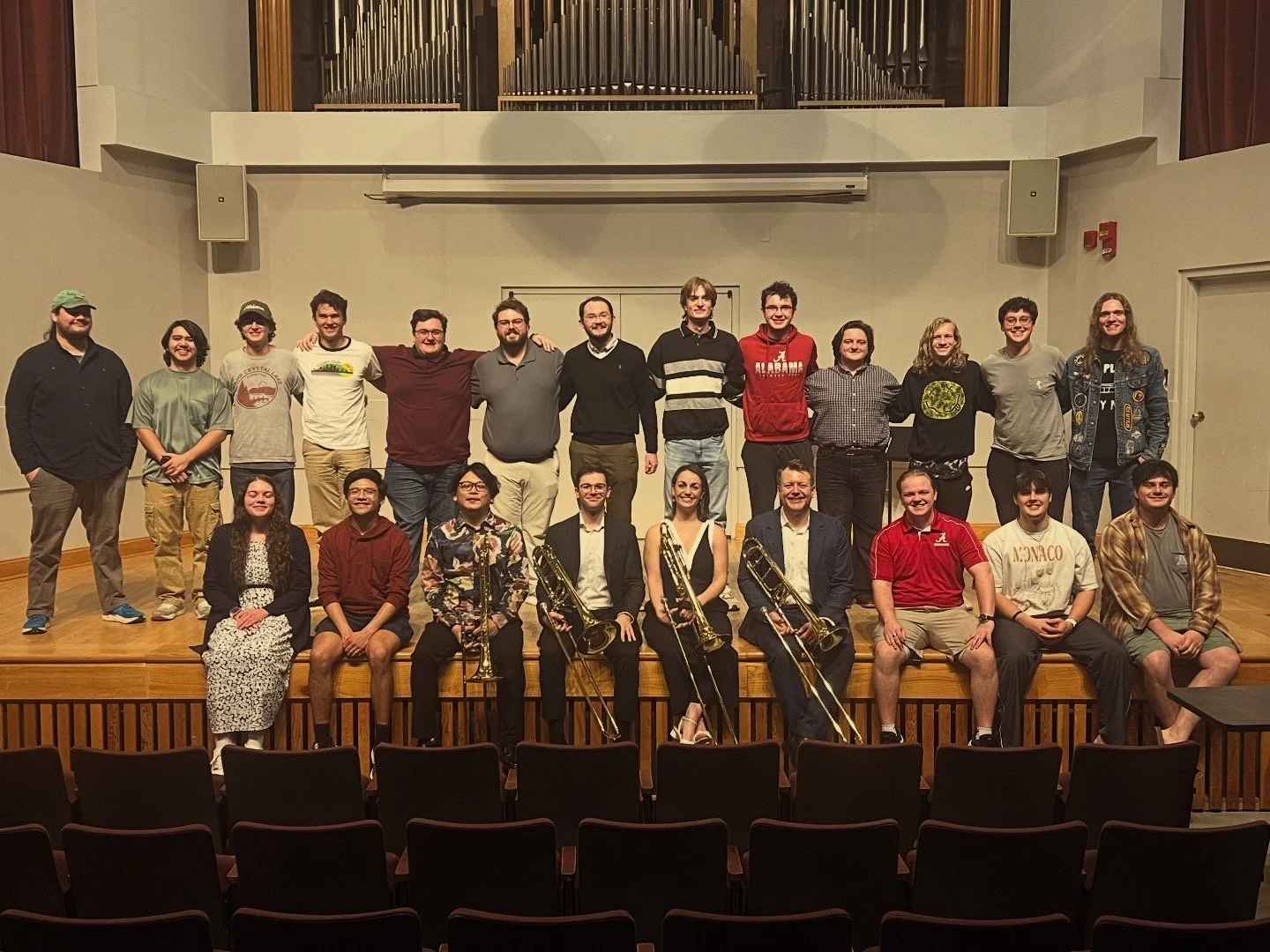
UA Trombone Studio members with Ascension Trombone Quartet after their UA Guest Recital in February!
Front row L-R: Faith Redden, Ian Zalamea, Yu Tamaki Hoso, Chris Bassett, Nikki Abissi, Colin Williams, Ethan Roberts, UA Tuba Studio member Ephraim Nunnally, UATS alumnus Connor Baggette Back Row L-R: Isaac Dashner, Dakota Ingram, Lawson Long, Lane Bailey, UATS alumnus Drew Campbell, Andrew Bolton, studio TA Ben Dondanville, Davis Brewster, James Diffey, Andrew Braun, Brock Panzeri, Murphy Branch, Gibson Purser
Welcome to the UA Trombone Studio Blog
I know most of you stay connected through our social media channels, but I thought it would be nice to add a blog as another way to share updates and reflections. I am sure the purpose of this space will evolve over time, so thank you in advance for sticking with me as I find the right rhythm for it.
The semester has been full. Between weekly lessons, rehearsals, performances, outreach events, recitals, and audition season, there has not been much downtime. I have been busy teaching, students have been practicing, ensembles have been rehearsing, and the momentum has been strong.
In the middle of these demanding seasons, it is important to slow down long enough to appreciate what is happening. You can control the pace more than you think. Sometimes it starts with something as simple as taking a breath and being fully present in the moment.
It is easy to become so focused on getting everything perfect that we forget how fortunate we are to have these opportunities. The rehearsals, the performances, the auditions, even the long practice sessions are privileges. Do the work. Hold high standards. But do not miss the joy that comes with it.
More soon.
Roll Tide and Roll Slide!